Zenit Bank. Building a Cross-Channel Anti-Fraud System from Scratch

This was my first major project delivering an end-to-end system. With digital service channels growing rapidly and fraud schemes becoming increasingly sophisticated, the Bank needed to move from a patchwork of separate anti-fraud tools to a unified risk management system.
When the project started, anti-fraud controls covered card transactions only, while the other transaction channels were effectively unmonitored. Without end-to-end event correlation across channels, detection quality was low, false positives were excessive, and the customer experience suffered.
The goal was to build a unified anti-fraud platform capable of analyzing customer behavior across every channel of interaction with the Bank in real time, identifying complex multi-step fraud scenarios, and reducing both direct financial losses and operating costs.
Scope and Solution Architecture
The project covered the full range of preparatory activities:
- presenting the business case to the bank's management board;
- defining business and functional requirements;
- selecting the technology vendor;
- designing the target implementation architecture.
IBM Safer Payments was chosen as the decision-making platform, offering high performance, flexible configuration, and support for real-time processing of transactions and events.
The integrated channels included:
- mobile and internet banking, including payment and non-payment events;
- card transactions (CNP, POS, ATM);
- P2P and Faster Payments System (SBP) transfers;
- 3-D Secure versions 1.0 and 2.0;
- the CFT core banking system.
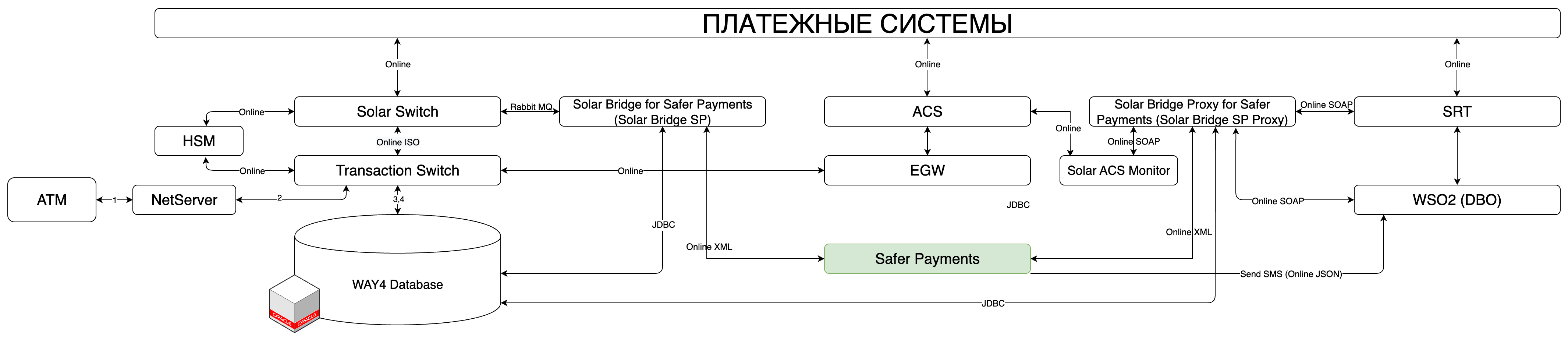
The wide range of integrated channels called for a sophisticated integration layer, including mechanisms for correlating chains of transactions and events, delivering customer data, calling external systems, and keeping decisions consistent in real time.
Cross-Channel Approach and Detection Logic
The defining feature of the project was a shift away from assessing individual transactions in isolation toward analyzing chains of events and customer behavior.
Detection took into account:
- the sequence of customer actions across channels;
- changes in behavioral patterns;
- links between devices, IP addresses, and geolocations;
- time correlations between digital banking logins, changes to account details, and financial transactions.
For example, a phone number change in the mobile app, followed by a login from a new device and a large outgoing transfer, was treated by the system as a single risk scenario, even if none of the events exceeded the set risk thresholds on its own.
A Combined Approach to Decision-Making
The project implemented a combined approach that brought together scoring models and rule-based logic.
We deployed:
- scoring models to detect known fraud scenarios;
- behavioral anomaly detection models;
- dynamic risk scoring for customers and devices;
- adaptive rules with automatic threshold calibration.
Scoring models worked alongside business rules, ensuring transparent decisions, regulatory compliance, and the ability to audit quickly. Particular attention was paid to model explainability and controllability.
Process Design and Change Management
The project transformed not only the technology but also the processes of the anti-fraud function:
- redesigning anti-fraud investigation processes;
- rolling out a unified case management system;
- training analysts to work with cross-channel scenarios;
- setting up SLAs between the anti-fraud unit, the contact center, and IT.
Channels were migrated in phases, with minimal impact on customers and key business metrics.
Results
Following the system launch, the Bank achieved:
- a fully modernized, mature anti-fraud function ready to handle complex fraud scenarios;
- a substantial reduction in direct fraud losses;
- a significant decrease in false positives;
- faster incident response times;
- greater transparency and manageability of the anti-fraud unit.
Takeaways
The cross-channel anti-fraud system enabled the Bank to move from reactive control of individual transactions to proactive risk management based on each customer's behavior. This approach laid the foundation for further development of risk-based services, personalized limits, and deep integration of anti-fraud into the Bank's overall decision-making system.
← Back to projects